
Shouting Into A Void
📢 You Are NOT Your Audience 📢


"Where there is shouting, there is no true knowledge."
-Leonardo da Vinci
Who are we trying to convince?
Lately, I’ve been losing my patience with internal Jewish debates (this should surprise almost no one, given my well-documented impatience).
Every week brings another article, sermon, podcast, or social media thread about antisemitism, anti-Zionism, Israel, Jewish engagement, or the future of the Jewish community. And increasingly, I find myself thinking the same thing: Will anyone we need to convince find this convincing?
I have my doubts.
And the strange part is that I feel the same way when I agree with the author.
Because if your goal is to persuade people, writing for people who already share your assumptions is a curious strategy. Most of the people we need to convince are not spending their days thinking about our concerns. They are thinking about their concerns.
And worse, increasingly, there seems to be a growing consensus among Jewish opinion leaders that if people do not act the way we want them to, it necessarily follows that they don’t care about us. This is a faulty and dangerous assumption.
Unless we understand how people decide that a problem matters to them in the first place, our arguments are unlikely to travel very far, and we will continue to shout into a void.
Which brings us to this week’s big idea.
Situational Theory of Problem Solving (STOPS)
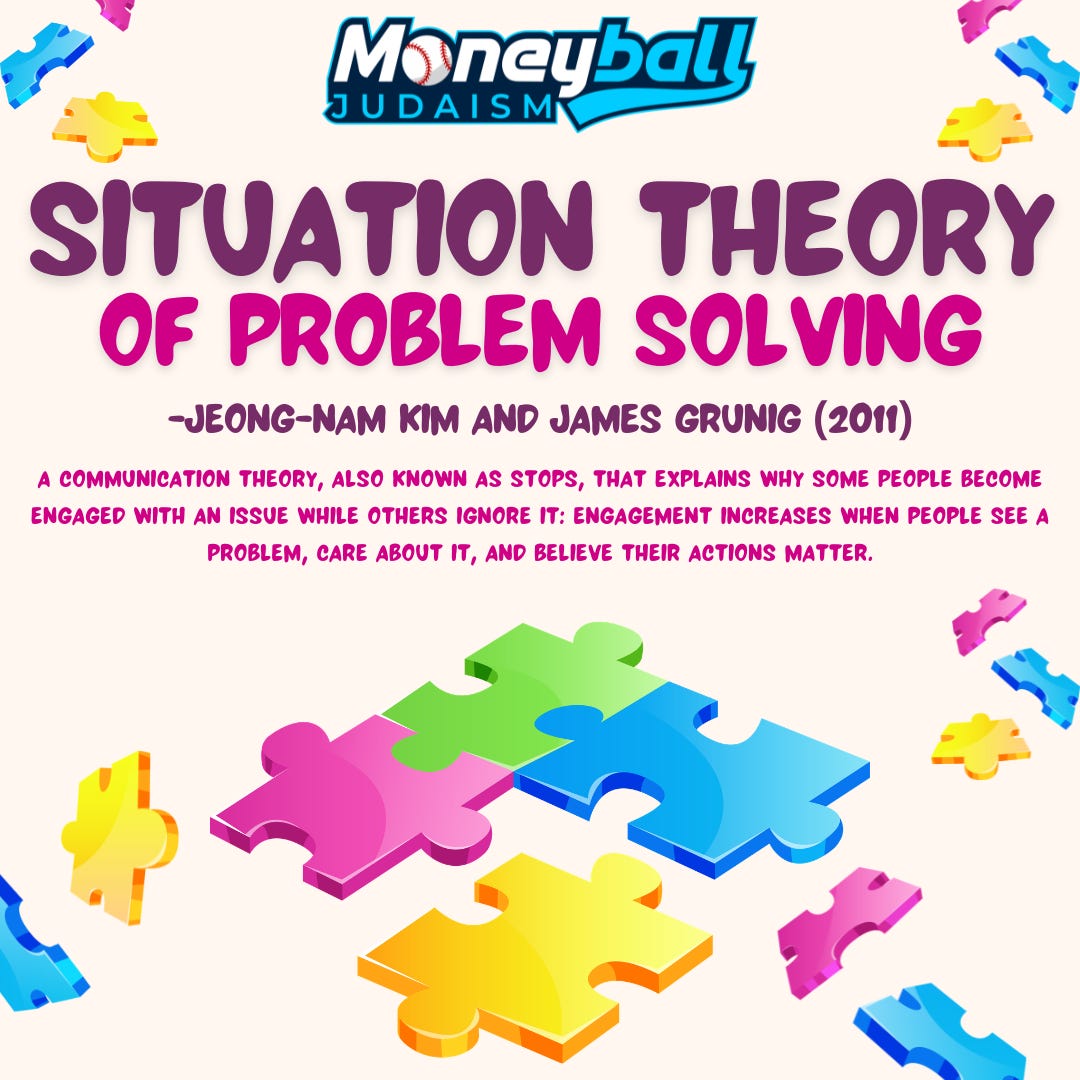
Why do some people become passionate while others remain passive?
The answer begins with the Situational Theory of Problem Solving, a theory of communication also known as STOPS.
Developed by Jeong-Nam Kim and James Grunig in 2011, STOPS argues that communication is fundamentally a tool for solving problems. People become increasingly active in seeking, evaluating, and sharing information when they recognize a problem, feel personally involved in it, and believe they can do something about it.
Kim and Grunig developed the theory to explain what they call “communicative action in problem solving”—the ways people seek, evaluate, and share information when confronting a challenge that matters to them.1 The authors argue that once a person recognizes a problem worth solving, “his or her communicative activeness increases in three communication behavioral domains—information acquisition, transmission, and selection.”2
Information acquisition refers to learning more about a problem.
Information transmission involves sharing information with others.
Information selection concerns deciding which information is relevant, trustworthy, and useful.
Some people actively seek information, scrutinize competing claims, and share what they learn. Others simply absorb information that happens to cross their path and move on with their lives.
The central insight of STOPS is that people become active communicators when they are motivated by a problem. As Kim and Grunig write, “information behaviors are most likely to increase when individuals are motivated because they recognize problems and involvement and do not feel constrained.”3 In other words, people become engaged when they believe a problem affects them personally and when they feel they have some ability to influence the outcome.
This has enormous implications for leaders.
But STOPS suggests a different approach. If people do not see a problem as relevant to their lives, they are unlikely to devote much attention to it. And if they do not believe they can do anything about it, they are unlikely to act even if they agree with us. And since you already care about some of the problems mentioned above, your passion will not be properly harnessed unless you see the problem you care about through someone else’s eyes.
Which is why this week’s book recommendation is such a useful companion.
Range

If solving difficult problems requires understanding multiple perspectives, what kind of person is best equipped to do that? David Epstein’s Range offers an intriguing answer.
Epstein explores why highly credentialed experts can become “so narrow-minded that they actually get worse with experience, even while becoming more confident.”4 Readers of this newsletter will recognize the pattern. We have previously discussed the law of the instrument;5 once a person learns a particular tool, they begin to see opportunities to use it everywhere (even when that tool is a bad choice). Likewise, the Dunning-Kruger effect reminds us that believing we know more than we actually do leads to unconscious incompetence.6
The more specialized we become, the more accustomed we become to approaching problems in a particular way. Over time, we can lose sight of what fresh eyes and broader perspectives might reveal.
Epstein builds on the research of our friends Daniel Kahneman and Gary Klein, who found that whether experience produces expertise depends heavily on the environment.7 For example, a person who plays chess or poker gets better with experience because these are subjects where patterns “repeat over and over, and feedback is extremely accurate and usually very rapid.”8 However, when a person needs to predict financial or political trends, “the rules of the game are often unclear or incomplete,” and consistent patterns are less common.9 And worse, when a person has inside information about a problem, they are more likely to affirm their existing assumptions and make more extreme judgments.10
Instead, Range argues that generalists often possess important advantages. They are more likely to identify the “deep structure” of a problem before deciding how to solve it.11 They are also more likely to “excavate old knowledge but wield it in a new way,” drawing connections that specialists may overlook.12
This brings us back to the challenge facing many Jewish institutions.
The uncomfortable reality is that many of our internal conversations are not attempts at persuasion at all.
They are performances.
We write for people who already agree with us. We speak to audiences that already share our assumptions. We celebrate arguments that earn applause from our personal and professional networks.
But if everyone reading your article already agrees with you, your biggest communication problem may not be your message.
It may be your audience.
The Daily Stoic
12
Ever memorized a part of John Milton’s Paradise Lost?
Me neither.
But the late John Basinger did; all 12 volumes.
Mad respect.
What I Read This Week

Andrew Tate’s Empire of Abuse: Andrew Tate is a loser who spreads nonsense to young men around the world. He’s also very, very dangerous. Read this profile in The New Yorker, and be sure to dissuade anyone you know from listening to him.
On the Nature of Autobiographical Memory: Relatively speaking, I think I’ve been blessed with a very good memory, including, but not limited to, my own autobiography. So I particularly enjoyed this beautiful article in The American Scholar about the distinct ways people experience the past and why memory is not merely a storage system.
The Indianapolis Clowns Play Banana-Ball: I still haven’t seen the Savannah Bananas live, although I’m a big fan. But this piece in The Atlantic offers a nuanced look at the organization’s resurrection of the Indianapolis Clowns, a Negro League baseball team, and the complexities that come with that decision.
Kansas City’s $25 Million World Cup Jail: Rahm Emanuel is my hero for saying “no” to the onerous financial expectations FIFA places on cities, which is why Chicago is not hosting the World Cup. This contrasts with Kansas City, whose journey to build a jail specifically for this event is kind of horrifying.
A Family’s Life of Crime: Barry Meier is an exceptional investigative journalist, and I’m used to seeing his name attached to deep investigations into corporate malfeasance. But this piece in The Atavist was a provocative look at a very different kind of story.
Ibid., 127.
Ibid., 143.
Hammer and Nails

“We become what we behold. We shape our tools, and then our tools shape us.” -Marshall McLuhan

Ibid.
Ibid.
Ibid., 109-110.
Ibid., 115.