
Authority’s Alibi
⚖️ Who Are You? Your Role of Your Identity? ⚖️

“I’m not confused. I’m just well-mixed.”
-Robert Frost
One major topic continues to be ignored in conversations about talent pipeline issues in Jewish organizations:
Israel.
Deep breaths, friends.
As a reminder, this is not a newsletter where I share my views on this topic and/or expect you to agree with me. But if our work is about getting on the balcony to look at what bigger forces may be impacting our organizations, and how we need to bring some of these questions to the surface. In the rabbinate, the colloquial term “death by Israel sermon”1 was becoming widely used before the October 7th massacre; one can only imagine how much worse it’s become since that horrible day, and not just for rabbis.
Your viewpoints or your organization’s viewpoints are immaterial. Frankly, all it takes is a misalignment between your views and your organization’s stance to create a conflict, regardless of whether your views are left, right, center, etc. And while any leadership role involves some conflict between personal beliefs and organizational health, issues related to Israel and Palestine are not “normal” in any sense of the word. Emotions run high, and jobs are often on the line when the wrong person gets angry.
Like many questions, balancing your job and your principles is not a problem that can be perfectly solved; it’s a tension that must be constantly managed. But it’s worth bringing to the surface how this topic could be discussed more, which brings us to this week’s big idea.
Role Morality
I am a rabbi.
I am also a Jew.
And while those two things are intimately related, they are not the same thing. The former is a profession or a spiritual calling; the latter is the center of my religious identity. But each label is also a kind of role, and at times, each will interact with this week’s big idea: role morality.
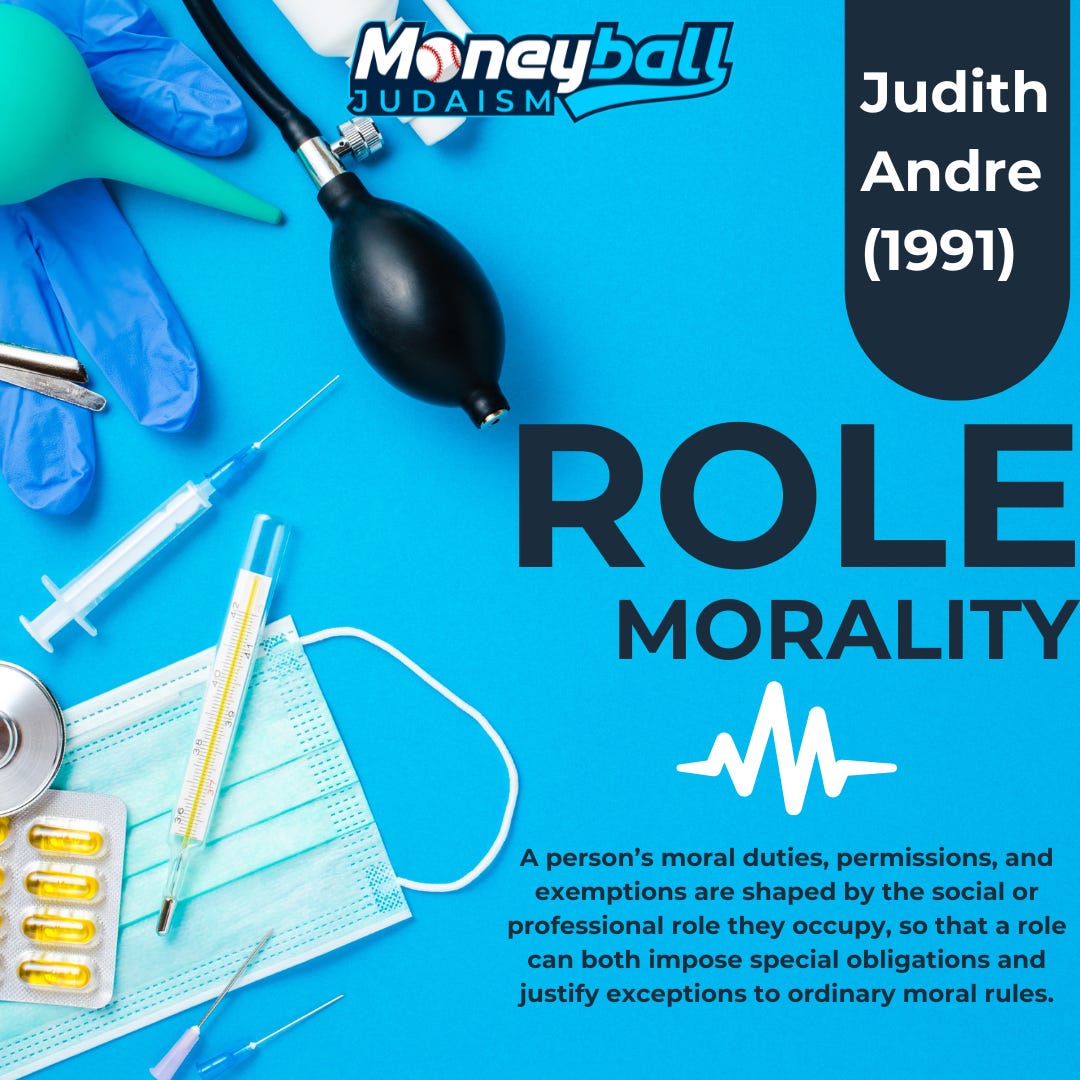
Role morality is the idea that a person’s moral duties, permissions, and exemptions are shaped by the social or professional role they occupy, so that a role can both impose special obligations and justify exceptions to ordinary moral rules. Here is a helpful summary from Ethics Unwrapped:
In practical terms, role morality can be used to justify situational behavior that is good, bad, or morally neutral. For example, imagine you are a doctor in a public place when someone suddenly cries out, “I need a doctor!” One doctor might choose to assist, even though they are not officially working, because they believe their medical expertise carries moral weight in an emergency. Another doctor might decide not to act, reasoning that they are not formally occupying the role of physician at that moment and that intervening could expose them to legal or professional risk. In both cases, the decision turns on how the doctor understands the boundaries of their role and when their moral obligations apply.
The first deep exploration of role morality is Judith Andre’s 1991 paper, “Role Morality as a Complex Instance of Ordinary Morality.” Andre argues that roles play a critical role in shaping moral reasoning because “morally relevant circumstances include a description of the agent: her abilities, promises she has made, expectations which exist about her, and so on.”2 Additionally, because people frequently expect “role behavior,” role expectations affect how we understand a person’s ethical duties.3
Returning ot the previous example, I am not a doctor; as such, no one expects that I can provide emergency medical care. The only reason the above example is complicated is that a doctor has internal expectations on their obligations to provide medical care, and society places expectations on doctors to provide medical care even when they are not “working.”
Andre also observes that “When a role is a bad thing, we have a different kind of duty: to ignore what is expected and to try to change it.”4 This principle applies when employees are asked to carry out tasks that are illegal or unethical. In such cases, they face a moral tension between the obligations of their role and their duty to act in accordance with broader moral principles. Refusing to follow these harmful directives may risk their job, yet it aligns with the duty Andre describes to act against the expectations of a morally compromised role.
This brings us back to my original question.
While I am withholding my opinion on what stance any Jewish leader should take, it’s essential to recognize that Andre's questions about role morality can apply to several aspects of this topic in your leadership practice, especially on issues related to Israel and Palestine, which in and of itself has its own moral complexity. And while we will never resolve this tension, we can name it. And in naming it, we create space for greater compassion for one another as we try to do our best, regardless of where we stand.
Empire of Pain

Of course, the stakes of role morality vary depending on the setting and issue. But to take this question to the extreme in a secular setting, consider reading Patrick Radden Keefe’s Empire of Pain: The Secret History of the Sackler Dynasty, a history of one’s family fortune and its relationship to the current opioid epidemic.5
For our purposes, I want to focus on the story of Dr. Arthur Sackler, the family patriarch, and how a medical doctor made his professional fortune primarily as a marketer rather than a physician. In the 1950s, Sackler was instrumental in developing an advertising strategy for an antibiotic called Terramycin. While previously there was an assumption that it was impossible to create product differentiation among pharmaceuticals, Sackler adopted “the seductive pizzazz of most traditional advertising–catchy copy, splashy graphics,” focusing on medical journals and opportunities for physicians to learn about well-known colleagues who also prescribed this drug.6 Even then, several colleagues were not comfortable using advertising techniques to promote pharmaceuticals, with one, Charles May of Columbia Medical School, warning that these tactics would lead to an “unwholesome entanglement” between clinicians and marketers.7 In response, Sackler “brushed off such critiques” by claiming that he wasn’t doing advertising, but education.8
Not only did Arthur Sackler not see any ethical conflict, but he also doubled down on his strategies for the rest of his career, particularly in the advertising of Valium, which eventually became the first drug in the United States to reach $100 million in sales.9 During this time, Sackler started publishing a weekly newsletter for doctors called Medical Tribune, which was distributed for free thanks to advertising from pharmaceutical companies, with one of the largest advertisers being Roche, the company that developed Valium.10
Fast forward to the present day, where Arthur Sackler is no longer alive, but Dr. Richard Sackler is running Purdue Pharma, and Radden Keefe finds that litigation around OxyContin revealed that Richard Sackler, also a physician by training, “had been the architect and the ringleader of the OxyContin campaign.”11 When asked how he felt about his behavior, Richard Sackler said in a deposition that “I don’t regret trying to energize our sales force.”12
In both the past and the present, notice how Arthur Sackler’s early statements and Richard Sackler’s more recent ones demonstrate tension around role morality outlined by Judith Andre. Both Arthur and Richard Sackler held medical degrees, and each insisted on being referred to as “Dr. Sackler,” as the prefix “Dr.” carries cultural cache. But both Dr. Sacklers were also working as marketers, a very different role with a different set of public assumptions. And while the Sackler family also became known for philanthropy in a variety of settings, including medicine, Radden Keefe also recounts how company leaders consistently refused to devote any of that philanthropy to addiction treatment.13 Apparently, while the Sacklers felt on solid ground to make enormous profits from drugs that could lead to addiction, they did not feel the same obligation to use advertising as a means of public education and harm reduction.
As always, I’ll let each reader decide when you experience an ethical conflict around your role as it pertains to Israel and Palestine (or any number of other potential topics). But while there is no way to “solve” the issue, ignoring it may be doing more harm than good to everyone involved. And as we enter 2026, let’s not forget to keep asking tough questions to shed light on the questions we too often keep in the dark.
The New Yorker Radio Hour
3.2 Billion
The total number of MetroCards sold by the city of New York since it was introduced in 1994.
What I Read This Week

AI Makes Decisions Than Humans. Why Don’t We Listen?: As you may be aware, I’m looking forward to the day when the robot drives my car for me. But this article in The Wall Street Journal explores why people continue to distrust AI’s ability to make decisions.
The Ritual Shaming of Kristin Cabot: It remains disturbing to me how we know when someone is about to become a victim of social media shaming. So I find myself reflecting after reading this profile of Kristin Cabot, whose 15 minutes of shame began at a Coldplay concert.
Nick Reiner’s Addiction: Nick Reiner is innocent until proven guilty. However, a child who struggled with drug addiction his entire life, murdering his parents, raises several complicated questions that families dealing with addiction can relate to. Read more here.
How Sports Stadiums Went Luxe: Every sports fan knows that stadiums play an outsized role in professional sports.14 But John Seabrook explores the idea that a simple stadium is no longer enough.
The Weakness of Strongmen: I find politicians who become authoritarians dangerous and pathetic, in equal measure. This piece in Foreign Affairs provides an in-depth look at how to defeat authoritarianism.
Ibid., 74.
Ibid., 76.
For those among you who are busy and do not have time to read the entire book, Radden Keefe also has a great 2017 piece in The New Yorker on this, entitled “The Family that Built an Empire of Pain.”
Ibid., 39.
Ibid.
Ibid., 58.
Ibid., 59.
Ibid., 336.
Ibid., 337.
Ibid., 245-246.
Cough, cough…Robert Irsay.
Yeah, we’re still bitter.
Apparently, I also recently learned that Irsay was born Jewish and denied his entire life that he was Jewish. So there’s also that…